
Let me ask you a question. How many total contacts did your donor receive last year? If you can answer that question by looking at a dashboard or using a simple query of some kind, congratulations to you and to your data team!
From my experience, many non-profit marketing leaders would not be able to answer that question easily. The reason for that is the siloed nature of many channels, outsourcing of some channel management to various vendors, and campaign measurement based on the ROI vs the holistic impact on the donor and their experience. Before I proceed further, there is often a good reason why channels are outsourced to vendors. Some vendors will have a unique expertise in the traditional paper mail campaigns, others in buying search ads, etc.
As data ecosystems change drastically through the advancement of AI and personalization, there are several potential benefits of structuring your data to allow coordination of channels at a donor level:
- AI-driven insights into your donors. Using a data structure demonstrated below, an AI engine (ChatGPT, Co-Pilot etc) can optimize the best channel engagement sequence, while leveraging cost effective channels.
- Cost optimization. The AI engine can be prompted to utilize cost effective channels first and if a desired outcome is achieved through those channels, then engagement through other channels can be reduced. Effectively creating a personalized donor journey.
- Donor Experience. If a donor is overwhelmed with communication, it might lead to tuning out organizational messaging. An optimized individual messaging plan can reduce the total engagement. For example, if a donor receives 170 messages in a hypothetical example below, a new plan could be 130 messages with a priority given to the channel more likely to reach the donor.
- Assigning A Lead Channel. In some cases it might be possible to use the AI to assign a “lead” channel or the channel that the donor most likely would be using to donate. In that case that channel would get communication priority during the busiest time of the fundraising calendar (E.g. Giving Tuesday or the end of the year). The other channels can be used to reinforce the message from the lead channel or scaled back to save money.
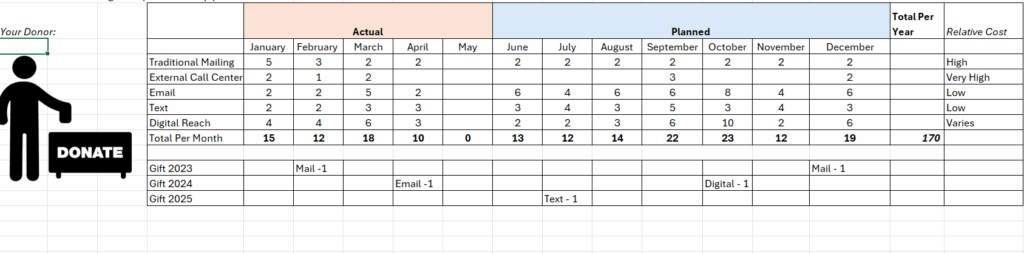
If you find this approach sound, work with your data team to see if you can structure your data to show engagement by channel at a donor level and then try a small-scale pilot with many AI vendors offering analytics services.